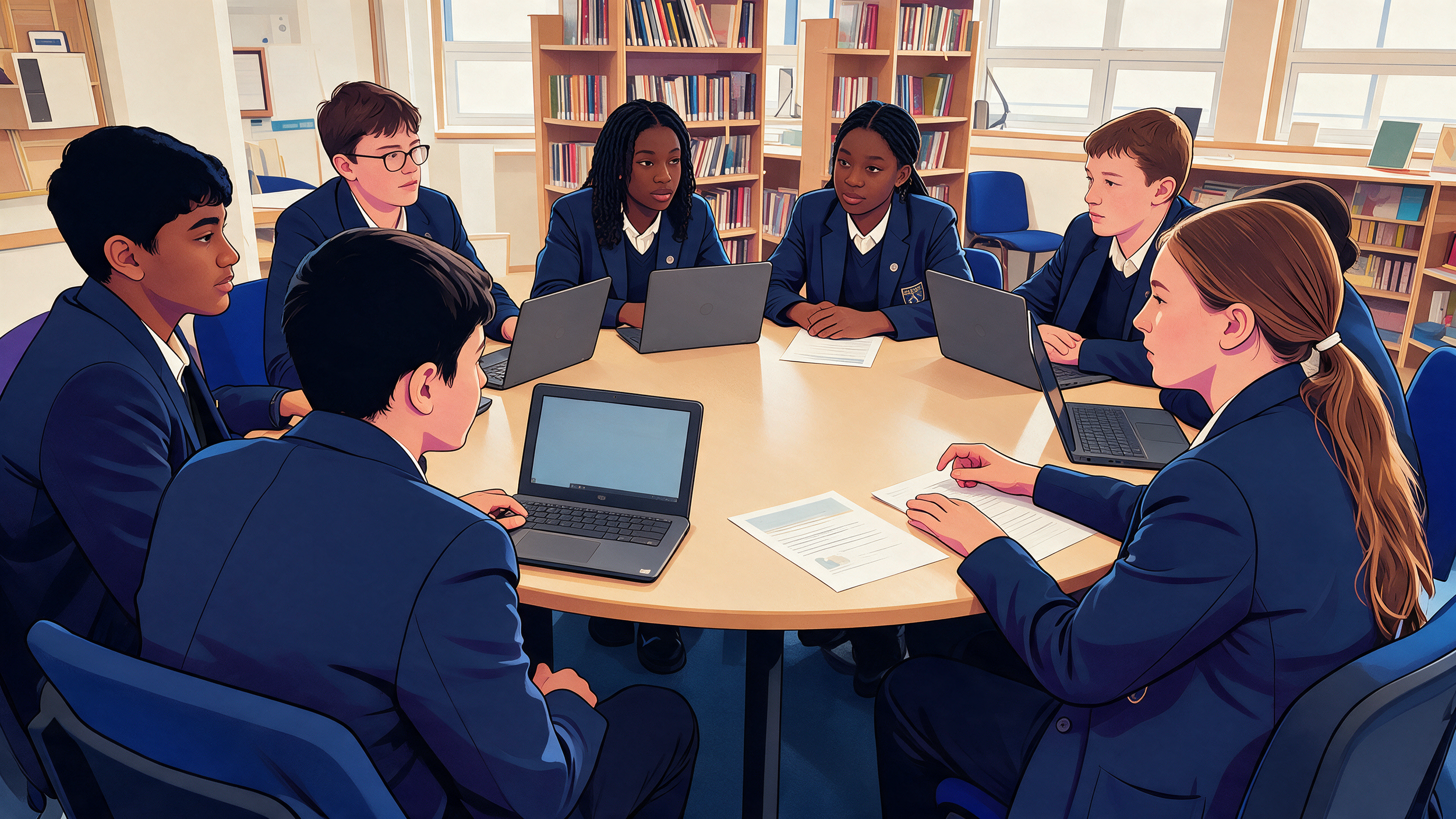
The Youth Council In The Room
Debating The New Climate Resilience Framework
The Climate Resilience Council Is In Open Session

The European Commission is preparing to adopt its new Climate Resilience Framework this autumn. But policy shouldn't be written for young people without hearing from them. Ahead of key debates scheduled for late October, there is a crucial window for classrooms to move beyond passive learning and exercise real democratic agency.
To bridge that gap, I’ve created The Climate Resilience Council a turnkey 60-minute classroom deliberation tool designed for secondary and upper-level students:
Step 1: Examine the expected structure of the EU’s 5-pillar framework, from risk ownership to resilience funding.
Step 2: Debate 6 core policy trade-offs (including whether adaptation rules should be legally binding and how youth needs are represented).
Step 3: Position & Submit draft position papers and pool classroom findings directly into the EU’s official Have Your Say feedback channel.
Young people will live with these climate risks the longest, yet youth and education currently lack dedicated representation in the proposed framework. This mini-curriculum gives educators an off-the-shelf way to build climate literacy, systems thinking, and active civic participation in a single lesson.
Get Involved: Run the session, capture your Youth Council's verdict, and make sure your students' voices reach decision-makers before adoption.
The Climate Resilience Council
The European Commission is about to adopt a new Climate Resilience Framework. In this exercise your class becomes a Youth Council. You read what is planned, debate the hard choices, and draft the position you would put to Brussels.
Reflects the expected structure ahead of adoption. Reviewed September 2026.What this is
A deliberation exercise. The class acts as a Youth Council examining the EU's expected Climate Resilience Framework before it is adopted, then drafts a short position. It works as a whole-class debate or in small groups, and takes about an hour. It needs no prior knowledge, only the briefing built into the tool.
What students should be able to do by the end
- Explain the main parts of the framework in plain terms.
- Use the ideas of risk ownership, residual risk, reference scenario, resilience by design and maladaptation.
- Weigh a real trade-off and give reasons for a side.
- Reach a shared position and justify it.
Suggested hour
Curriculum links
IB MYP Individuals and Societies. DP Global Politics and Environmental Systems and Societies. The EU sustainability competence framework GreenComp, in particular embracing complexity and acting for sustainability. Suits ages 13 and up, and adult corporate learning without change.
Examine the framework
Read each part. As a group, decide whether it is enough, and say what you would add or change.Lesson Resources
Five Parts Prep Reader
Student Notes & Checklist
Teacher Notes & Checklist
Youth Climate Resilience Survey
This is about having your say and recognising your impact.
If you’re working inside the 169to1® eco-system, transparency and relevance is key to sustainable action.
Select, Classify and Prove… Simple.