
The SDG Traffic Light Toolkit™
A Closer Look

Classifying Feasibility And Urgency
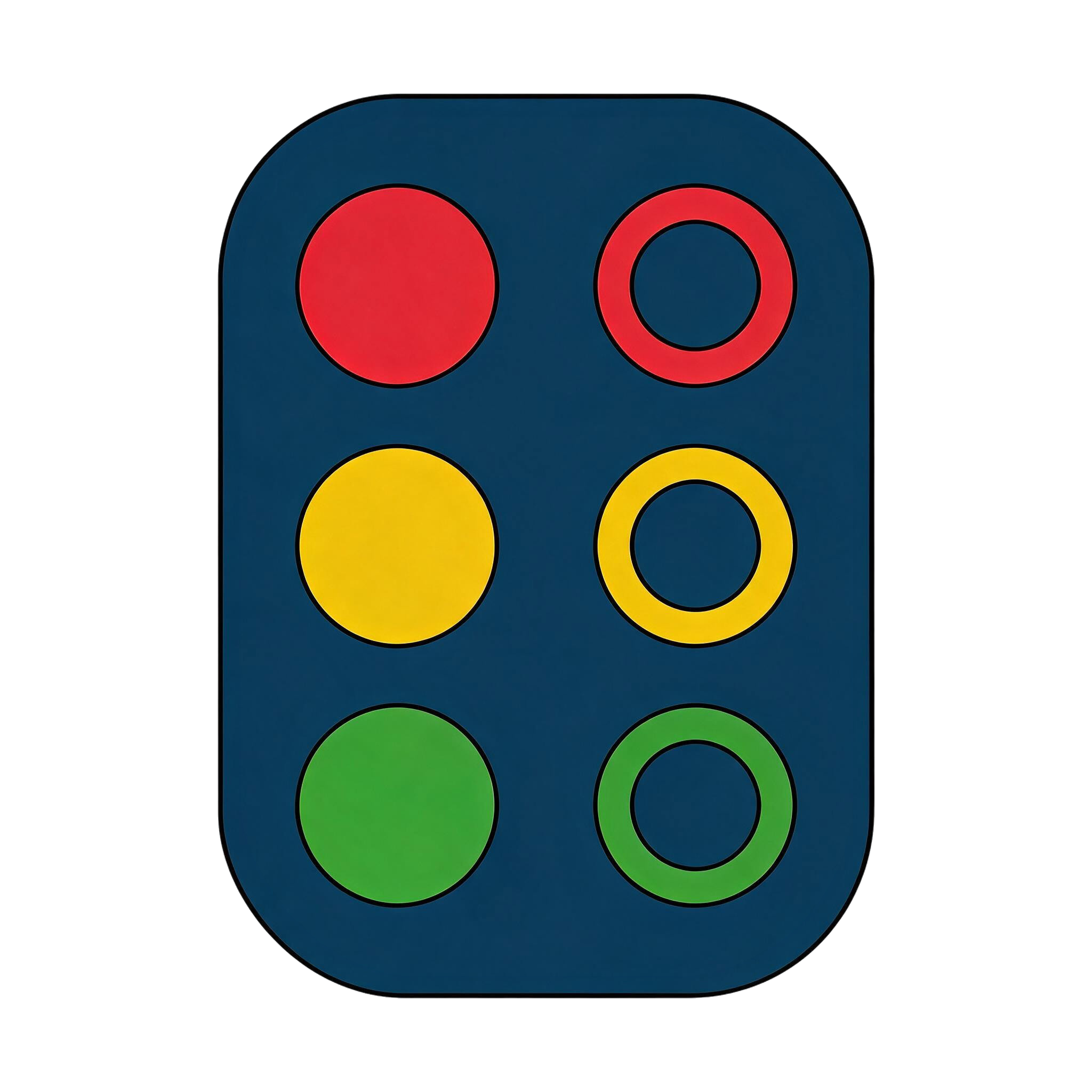
169 targets.Two readings each.
A target you could start on Monday and a target that needs an act of parliament are not the same job, yet the goal-level headline treats them identically. The toolkit classifies all 169 on two questions: how much of this can you deliver yourself, and how long can it wait.
Part one
The two readings
Both readings use the same three colours, which is what makes the toolkit fast to read and easy to misread. They are told apart by shape. Feasibility is a solid disc. Urgency is a ring. Each reading classifies the full 169 independently, so the counts below add to 169 twice over.
Feasibility
Solid disc · who has to be in the roomRequires legislative, structural or national policy change. You can advocate. You cannot deliver it.
Requires cooperation with local authorities, NGOs or sector partners before anything moves.
Can be led by an individual, an institution, a community or a small team, with no permission needed from anyone else.
Urgency
Ring · how long it can waitRequires immediate action, or delay causes permanent irreversible harm.
Needs attention within six to twelve months to avoid missed opportunities.
Still important. Can be planned or phased over time without losing the opportunity.
Part two
Reading the two together
A single colour tells you almost nothing on its own. Green feasibility with green urgency is a target you could do easily and can safely leave until next year. Green feasibility with a red ring is the strongest thing on your list. The pairing is the instrument; the individual colour is only half of it.
Green means opposite things on the two readings. On feasibility it says you can lead this. On urgency it says this can wait.
Anyone who reads the toolkit as a single green-to-red scale will conclude that the easy targets are also the ones that do not matter. That is exactly backwards, and it is why the two readings carry different shapes.
Feasibility. The solid disc from the mark. Green centre means you can lead it without waiting for a partner or a parliament.
Urgency. The outline from the mark. Red ring means the window is closing now.
Green centre, red ring. Fully within your gift and cannot wait. If your shortlist has one of these on it, nothing else should go first.
Starter suggestions · the nine pairings
The nine cells are readings, not counts. The row and column totals are the real figures for each reading on its own; the cross-tabulation of how many of the 169 sit in each individual cell is a separate calculation and is not shown here.
Part three
What the split actually says
These four figures follow from the counts above and nothing else. They are the argument for classifying before committing.
Roughly one in seven of the 169 targets is self-deliverable. These are the commitments a single team can start without waiting for anyone.
68 partnership-dependent plus 76 system-dependent. For the overwhelming majority of targets, the first deliverable is a conversation, not a project.
54 critical plus 63 high urgency. Roughly seven targets in ten carry a deadline that does not move for anyone’s planning cycle.
Under a third can be sequenced over time. Permission to phase the work is not permission to defer it indefinitely.
A goal-level claim averages all of this away. Classification is what turns 169 commitments into one thing you can start.
Part four
Where it leads
The toolkit answers what to do next. It does not answer how you prove you did it. That is a different question, and it belongs to a different instrument. The three connect in order.
Action Snapshot
Every target in the index opens into a single page: what the commitment asks for, what you could do about it at your own altitude, and what counts as having done it.
SDG Target Impact Index™
Direct links from each target to its matching indicators and Proof Points, so you can move from what to do next to how to prove it without leaving the framework.
Certifier badge
For when the claim has to hold up outside your own organisation. Submitted evidence, reviewed against a published rubric, with a validity period attached. Reading the toolkit is self-assessment. This is not.
Part five
Three ways it gets used
The same classification serves three different jobs, because each reading answers a question a different user was already asking.
As a classroom tool
The two readings give students a way to argue about a target without needing to have read the treaty. Feasibility asks who holds the power. Urgency asks who pays for delay.
As a team planner
Match resources against the pairings rather than the goals. Green centres go on the workplan. Amber centres go on the partnership list. Red centres go on the advocacy log.
As an advocacy map
The 76 system-dependent targets are the ones no organisation can deliver alone. Naming them as such is more honest than reporting against them and more useful than ignoring them.
Early-stage teams and schools often begin with the green centres, and that is a legitimate way in. The work is within reach and the wins are real. Read the ring before you commit, though. A green centre with a green ring is comfortable and can wait. A green centre with a red ring is comfortable and cannot. Start with the second, then come back for the rest.
169to1 is fully independent of the United Nations. Target numbering is reproduced for reference. The feasibility and urgency classifications, the counts shown here and all descriptive wording are 169to1’s own editorial reading and carry no UN endorsement.
© 2026 169to1® – Originally developed by Hudson Consultancy Online. Licensed for internal use. Redistribution or resale prohibited.
You don’t have to do everything…
Just start where you can make the most difference. We can help you light the way. Let’s go…