Democracy Outside The Box
Democratic Culture Made Easier

Finding The Voices Of Democratic Culture
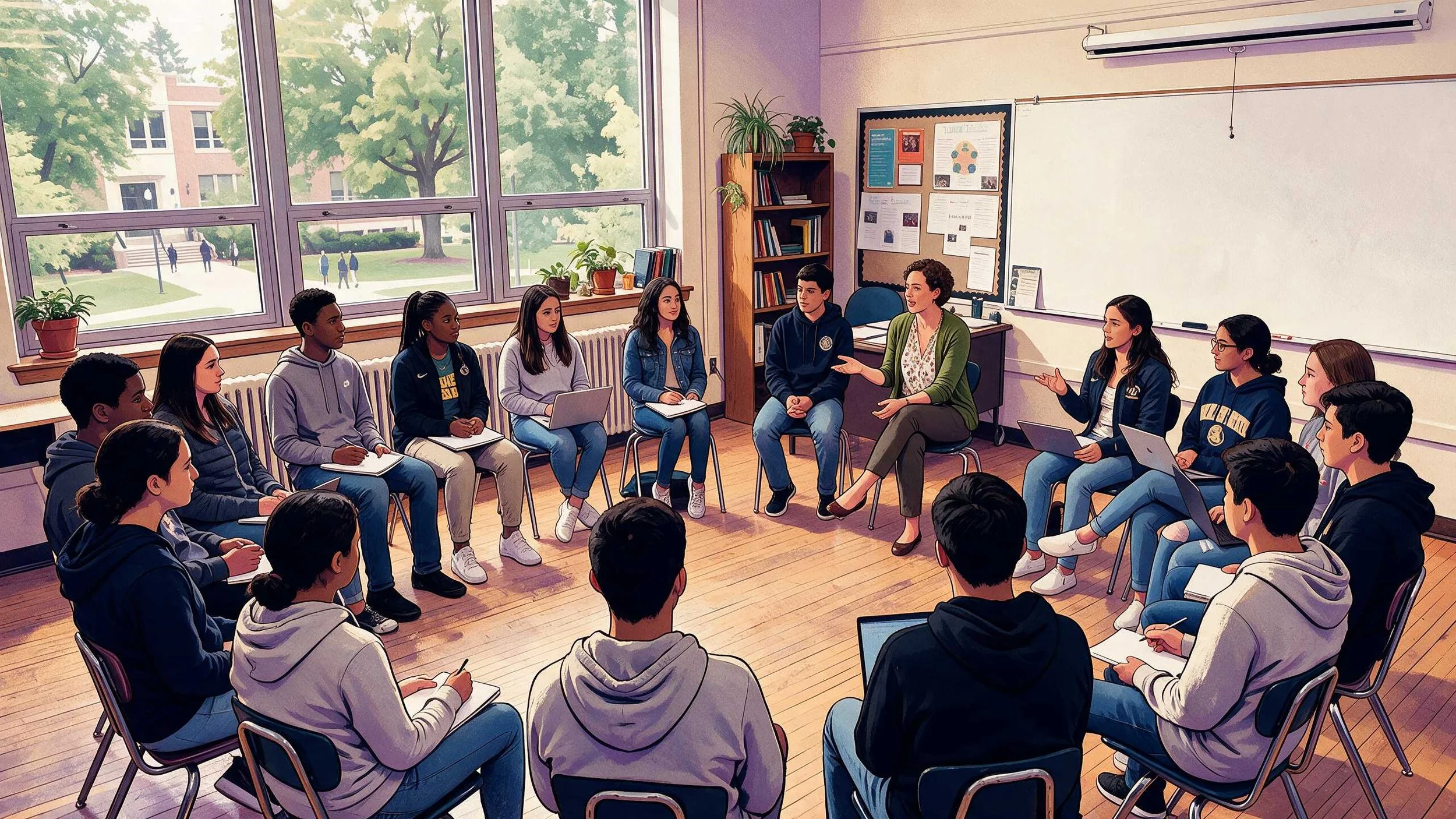
Democracy Outside The Box is a democratic citizenship curriculum for primary and secondary schools, built on the Council of Europe’s Reference Framework of Competences for Democratic Culture (RFCDC). It has 12 units and 36 lessons, each written for three age bands: 9 to 10, 11 to 13 and 14 to 16. Every unit asks one question: who decides this, and how can I have a say? The answer widens with age, from the class and school to the town, and then to the country and the EU, with examples from the UK, the EU and Türkiye. Units 10 to 12 form a Citizen Project, where the class takes a real local problem to the people with the power to fix it.
Each lesson names two to four RFCDC descriptors so teachers know what to look for, and learners keep a portfolio of evidence instead of being scored. Every unit comes with printable teacher, student and family sheets, and the tool includes summaries for primary and secondary teachers. Units link to GreenComp, DigComp and LifeComp, and the tool shows how it responds to the 2023 Council Conclusions on education for democratic citizenship.
This is the second of three features for the Outside The Box series.


Democracy Outside The Box
The second tool in the Outside The Box series: a democratic citizenship mini curriculum for learners aged 9 to 16. Twelve units start somewhere unexpected: a rule that appears overnight, a ball two groups both want, a feed that shows two people different worlds, a problem on the walk to school. Every unit has three 60-minute lessons, written for three age bands, with teacher, student and family sheets.
Built on the Council of Europe Reference Framework of Competences for Democratic Culture (RFCDC): 20 competences in plain English, with RFCDC Volume 2 descriptor numbers in every lesson. Linked to GreenComp and the SDG targets. Every unit asks the same question: who decides this, and how can I have a say? Background figures from the UK, the EU and Türkiye trace to named sources from 2020 onwards, checked on 18 October 2026.
All Units
Open a unit to read its three lessons for your age band. Switch between the teacher’s and student’s view, open any descriptor number to see what to look for, and add the unit to your pack for printing. Units 10 to 12 form one connected Citizen Project.
The 20 competences of the RFCDC, in four areas, renamed in plain English for teachers and learners. Open one to see what it looks like at each age band, the descriptors used in the lessons and the units that build it.
What To Look For, Not What To Tick. Each lesson names two to four RFCDC Volume 2 descriptors by number. They describe behaviour a teacher might notice during the activity. They are not a checklist and are never used to grade a learner’s values or opinions.
The eleven checks come from the Communication Pulse, as in GreenComp Outside The Box: nine ingredients from Planetary Communications (Stockholm Resilience Centre, 2026), grouped as Reliable, Relevant and Relatable, plus Listen First and Honest About Costs. In this tool they sit beside the RFCDC competences, which remain the spine. Open a check to see its levels and every lesson that uses it.
The Levels Judge The Work, Not The Learner. Learners use the checks to improve a letter, talk, message, fact-check or proposal before it goes out. The levels describe that piece of work. They are never used to judge a learner’s values, attitudes or opinions, which stay portfolio-only, as RFCDC Volume 3 advises.
Keeping Families In The Loop
Family Sheets For Each Unit
One A4 page per unit for your age band: what we are learning, questions to talk about at home, something to try together, how to help, and the portfolio moment. Open a unit to read it or print it.
The SDG targets these units work on, each with the competence that most directly develops it and the units that work on it. Open a target for its education snapshot.
An Editorial Mapping, Not An Official One. The RFCDC does not link its competences to SDG targets. The links here are 169to1’s, based on what learners do in each unit. Target wording is 169to1’s plain-English version, not official UN wording.
Did It Work?
Lesson 3 of every unit asks learners to check what happened after they had their say, and to report it fairly. Units 10 to 12 use it for the Citizen Project. Fill this in as a class or a group. It saves on this device only.
1What We Asked For
The change you asked for, who decides it, and how you would count it. The unit’s suggested measure appears once you choose a unit.
2Before And After
Measure the same thing, the same way, before and after.
3What The Decision-Maker Did
Choose all that apply, then describe it.
4How We Know
Evidence someone else could check.
5Our Verdict
6Fair Report Check
7Our Report
Built from your answers. Use it in a newsletter, a report to the school council or the portfolio.
Every figure in the units traces to a named source. This list shows each source with its title, date and link, the units that use it and what it supports. Frameworks come first.
How To Read This List. Reported means the figure comes from a news report of an official source, which is named in the entry. Every source is from 2020 onwards. Check figures again before quoting, as sources are updated.
Your Lesson Pack
Every lesson has a teacher’s sheet and a student’s sheet, one A4 page each, written for the age band you choose. Each unit also has a one-page overview for the teacher and a one-page family sheet.
Your pack is empty. Use Add To Pack on any unit, or add all twelve.
Printing opens the sheets on their own page. Use the Print button at the top, or on a phone use Share and then Print, to save a PDF. Each sheet is fixed to one A4 page.
Guides, Records And Family Sheets
Ready to print, in the same A4 format as the lesson sheets.
Teacher’s Guide
Two pages: how the curriculum works, the three-lesson pattern, the age bands, descriptors and portfolios, and a route through the year.
Primary Teacher’s Summary
Two pages for primary schools: the age band, how a unit runs, assessment, safety, families, and all 12 units with their lessons for ages 9 to 10.
Secondary Teacher’s Summary
Two pages for secondary schools: the age bands, real channels, assessment, safety, families, and all 12 units with their lessons for ages 11 to 13 and 14 to 16.
The 20 Competences
One page: the four areas and 20 competences in plain English, for the classroom wall.
Key Descriptor Snapshot
The 135 key descriptors from RFCDC Volume 2 in plain English, coloured by area and level, with those used in the lessons marked. A reference, not a checklist.
Curriculum Map
One page: all 12 units and 36 lessons at a glance, with competences, descriptors and SDG targets.
Checks Rubric And Score Sheet, Ages 11 To 16
Three pages: all eleven checks at four levels, and a score sheet for the piece of work.
Checks Poster, Ages 9 To 10
One page: eleven simple questions with three steps for checking a piece of work.
Family Letter And Consent Form
Two pages: how the curriculum works for families, and a consent form for activities outside the classroom.
Portfolio Record
One page for learners to log their evidence across the 12 units, with no scores or rating scales.
Did It Work? Record Sheet
One page for classes without devices: before and after, the decision-maker’s response, evidence, a verdict and a fair report check.
How We Addressed The Council Conclusions
Two pages: each point of the 2023 Council Conclusions on democratic citizenship that applies to schools, and what the tool does in response.
Source List
Every framework and source used in the units, with dates, links and the units that rely on them.
RFCDC Volume 2 · Reference Snapshot
The 135 Key Descriptors
In plain English, coloured by area and level as in Volume 2. A reference, not a checklist.