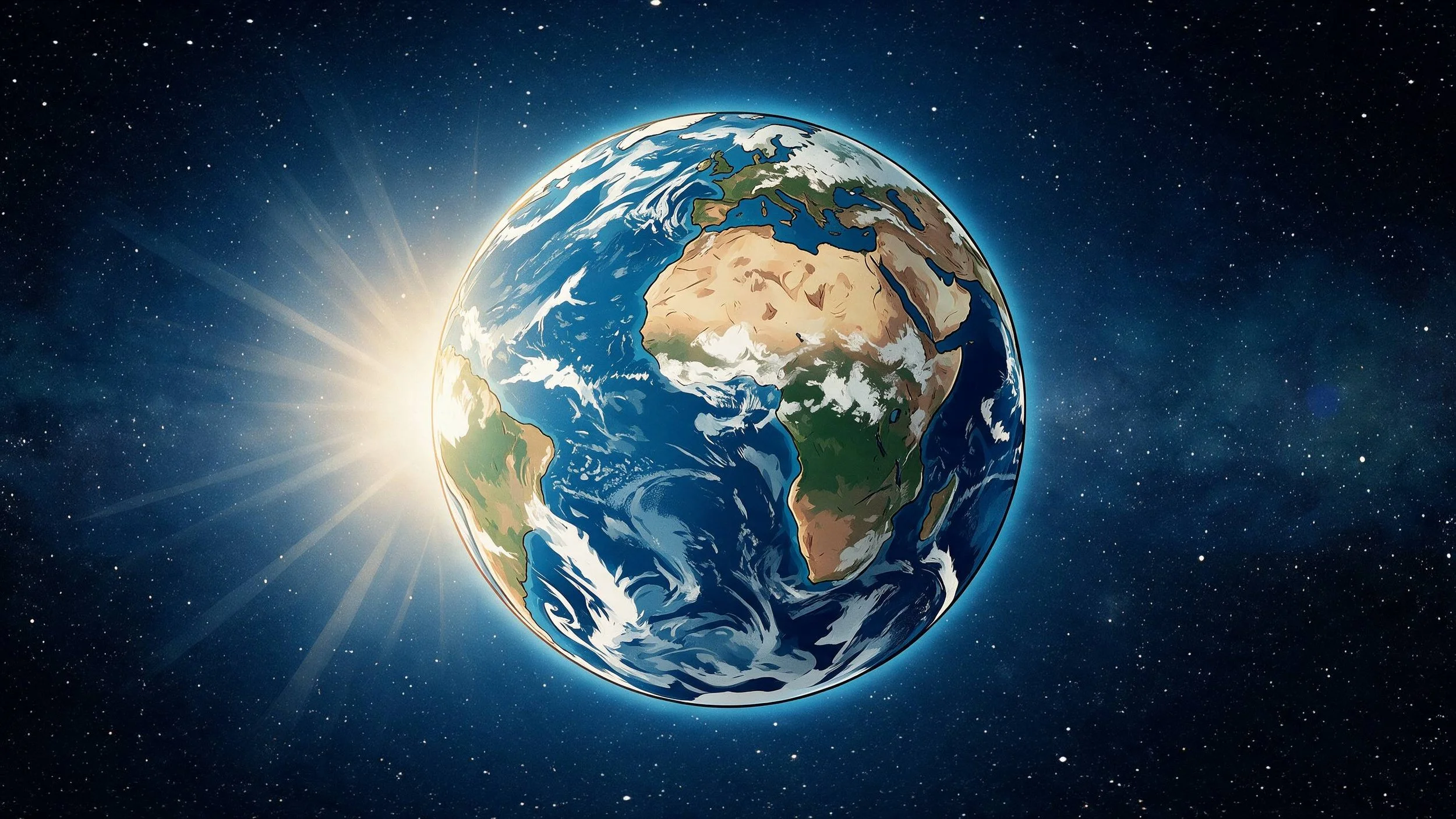
The Planetary Pulse
The Plain English Guide To The Planetary Boundaries
The Pulse of The Planet is Beating Fast
A free unofficial interactive guide to the nine planetary boundaries, the limits that keep Earth in the safe, stable state civilisation grew up in. Built on the Planetary Health Check 2026, the latest scientific assessment of the state of the planet, it turns the 120-page report into something you can read in plain English and use in a lesson. Every boundary has a live slider that starts where the world is today, so students can drag it into the green or the red and see what crossing it would mean, with each figure traced back to the science. Written to be clear for any reader, and ready for teaching in and out of the classroom for 11-16 year olds.
It works as the evidence half of a pair with the How to Live on Earth companion: Where the film gives the human story, the Pulse gives the instruments behind it. The Classroom tab carries a ready-to-use classroom activity and a field activity for each of the nine boundaries, every one mapped to the EU's GreenComp sustainability framework and to the SDG targets it helps prove. Alongside the boundaries you can see how they connect as one Earth system, the tipping points to watch for, the report's spotlights, and what can still be done.
Grounded throughout in the Planetary Health Check 2026, openly licensed under CC BY 4.0, independent of any institution, and ready to adapt to your own students and setting. The documentary it pairs with, How to Live on Earth, is free to screen on YouTube.
The Planetary Pulse
A plain-English read on the nine planetary boundaries: the guardrails that keep Earth in the safe, stable state civilisation grew up in. See where each one stands, drag the sliders to explore the zones, and bridge the science into the classroom.
Planetary figures and findings trace to the Planetary Health Check 2026 (PBScience), the third edition of the Planetary Boundaries assessment.
The Nine Boundaries
Choose a boundary to read what it measures, where it stands in 2026, and what moving the needle would mean. The slider starts where the world is now.
Sources And Method
The Planetary Science
All planetary figures, statuses, trends and findings are drawn from the Planetary Health Check 2026: A Scientific Assessment of the State of Our Planet, the third annual edition, published by Planetary Boundaries Science (PBScience) at the Potsdam Institute for Climate Impact Research.
Editors: Niklas Kitzmann, Boris Sakschewski, Levke Caesar and Johan Rockström. DOI 10.48485/pik.2026.25. Available at planetaryhealthcheck.org. The report is published under a Creative Commons Attribution 4.0 licence (CC BY 4.0).
The Planetary Boundaries framework it builds on was first set out by Rockström and colleagues in 2009. Photography in the report is by Mattias Klum.
What this tool does with it: boundary, baseline, high-risk and 2026 values are taken directly from the report's information sheets and its "Planetary Health at a Glance" summary. As the CC BY 4.0 licence requires, changes are indicated: the data are re-expressed here as interactive gauges and plain-English explanations, paraphrased rather than quoted. The report's own figures and Mattias Klum's photographs are not reproduced; the gauges, sliders and network diagram are original.
The GreenComp Framework
The competence tags on the Classroom lessons use the European sustainability competence framework: Bianchi, G., Pisiotis, U. and Cabrera Giraldez, M., GreenComp: The European Sustainability Competence Framework, Punie, Y. and Bacigalupo, M. (editors), EUR 30955 EN, Publications Office of the European Union, Luxembourg, 2022. ISBN 978-92-76-46485-3, DOI 10.2760/13286. Also published under CC BY 4.0.
The framework's four areas and twelve competences are used as published. Which competence each lesson develops is 169to1's editorial mapping, not an official designation.
The SDG Targets
The Sustainable Development Goal target wording is the United Nations' own. Which targets a boundary bears on, and the split between Direct and Supporting, are 169to1's editorial mapping rather than an official crosswalk. Ocean Acidification is the one exact match: target 14.3 names ocean acidification in its own text.
About This Tool
The Planetary Pulse is built and maintained by 169to1, an independent SDG implementation platform. It is not affiliated with, or endorsed by, PBScience, the Potsdam Institute, the European Commission or the United Nations. It draws on their openly licensed work and credits it above.
The tool, its plain-English writing, its gauges and its SDG and GreenComp mappings are 169to1's own work. Every claim is meant to trace to a named source; where a figure is uncertain, the tool shows that rather than inventing precision.
How To Read The Sliders
- The track runs from the safe operating space (green), through increasing risk (amber), into the high-risk zone (red to purple).
- The labels under each slider give the boundary, the high-risk line where the report sets one, and where the 2026 value sits.
- For forest cover, ocean aragonite and ozone a higher number is safer, so those tracks read green on the right. The logic still holds: green is safe, red is danger.
- Novel Entities has no quantified boundary, so its slider shows a position, not a measured value. Genetic diversity keeps its real thresholds, but its current marker reads "above 100, uncertain" rather than a false figure.
Built by 169to1 · Select, Classify, Prove · Planetary data from the Planetary Health Check 2026 (PBScience, CC BY 4.0). Competence framework: GreenComp (European Commission, JRC, CC BY 4.0). This tool summarises and teaches; the full science is in the report.