The School Garden Pulse

From Planning To Proving Your School Garden's Sustainability And Biodiversity

Gardening Together With Your School And Community

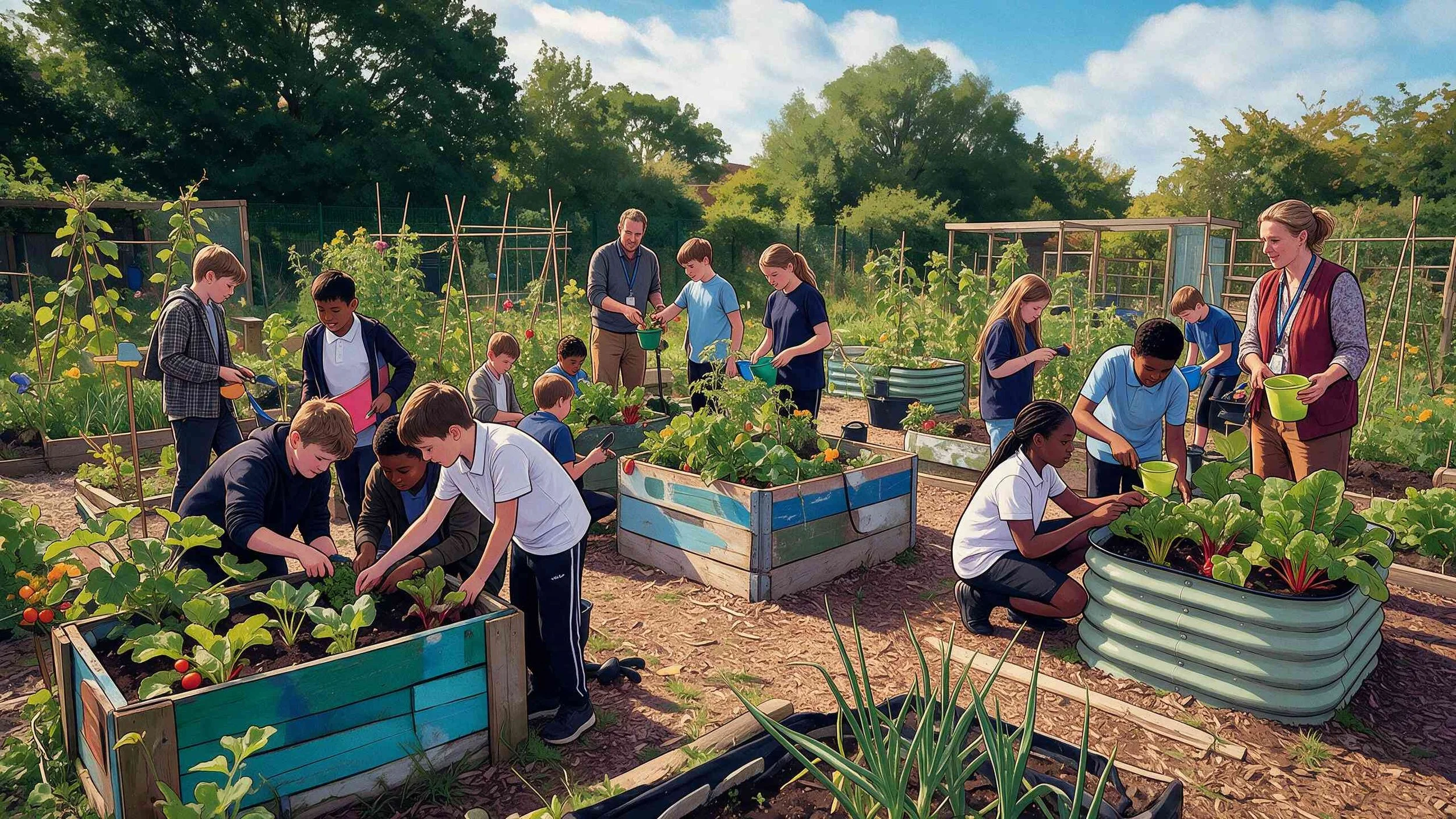
A free planning tool for community gardening as a practical, hands-on route into climate education. Built for schools and their partners in the UK, Europe and Türkiye, it helps students, teachers, families and local groups plan a garden together, with or without land, and adjusts every growing timeline to the local season and climate.

Choose from 30 garden features, from raised beds, ponds and compost bins to rainwater harvesting, vertical gardens and box hydroponics, each with materials, build steps and how it works. The Grow Guide covers 46 vegetables, 19 fruits and 13 herbs, with spacing, timing and companion plants. Lesson links connect the garden to climate action and the UN Sustainable Development Goals. A funding tab maps routes to local partners such as parent groups, businesses, councils, service clubs and community organisations. A Green School Standard self-check includes community gardens and events led by elders, and an inclusion barriers check helps make the garden open to everyone. A shared care rota and a Build & Prove section help the whole team take responsibility and record what the garden achieves.

Every figure traces to named sources, including the UK’s RHS, UNESCO, Jarau and Benkowitz’s EU Sustainability Education in School Garden-Based Learning and Türkiye's Ministry of National Education. The tool is ready to adapt to your own site, community and budget.

Select · Classify · Prove
Season Climate

School Garden Pulse

Plan, build and prove a school garden, with land or without it. Choose garden features, follow a growing guide set by season and climate, pair companion plants, plan for wildlife, find funding, and teach 19 garden lessons written for five age groups, from Ages 5 To 8 to Adult Learners.

Built on Sustainability Education In School Garden-Based Learning (Jarau and Benkowitz, eds., Springer, 2026, open access), with growing guidance from the RHS, FAO, UNESCO and the Turkish Ministry of National Education, cited in every tab.

30Garden Features
74Crops To Grow
19Garden Lessons
5Age Groups
Before You Start Growing guidance is general. Continental and Mediterranean timings are adjusted from the sources, and conditions vary by site and year. Check your own site, and follow your school's rules for tools, water, soil and food.
Where The Content Comes From
  1. Jarau, S. and Benkowitz, D. (eds.) (2026). Sustainability Education in School Garden-Based Learning. Springer, open access, Erasmus+. Cited by chapter throughout.
  2. Biodiversity dimensions draw on chapters 4, 6, 7, 8, 10, 11, 15, 16 and 17. The "extinction of experience" idea is from Chapter 1 (after Soga and Gaston).
  3. Companion planting: Chapter 13, compiled from Franck (1991) and Mayer (2022). The roles of common garden creatures follow standard garden ecology alongside the book's chapters on pollinators, soil life and vertebrates.
  4. The Papillon Project, a Norfolk charity that builds school allotments as permanent outdoor learning spaces (registered charity 1189383). StratKIT, School Gardening for Sustainable Food Education (Interreg Baltic Sea Region, EU). New European Bauhaus, The Edible School, Lisbon. Freight Farms, Green Thumbs at School. TGED Foundation, Low-Cost Vertical Models.
  5. Growing guide: RHS Step-by-Step Veg Patch (DK) and the RHS crop planner; Whittingham, J. Grow Easy Vegetables (DK). Türkiye: T.C. Millî Eğitim Bakanlığı MEGEP modules Sebzecilik (2007), Hobi Bahçeleri (2016) and Çiçek ve Çiçek Tablası Yenen Sebzeler; Samsun Provincial Agriculture Directorate, Sebzecilik. Mediterranean: Monchique Homestead, Easy Vegetables to Grow for Beginners in a Mediterranean Climate (2026).
  6. Funding: RHS Campaign for School Gardening, A Guide to Funding Your School Garden. Green School: UNESCO (2024), Green School Quality Standard: Greening Every Learning Environment. Inclusion: Erasmus+ GARDENS, Inclusive Approaches to Community Gardening and Green Learning Spaces. WWF, Schools Sustainability Guide.
  7. Garden features: RHS, Terrariums and Bottle Gardens (rhs.org.uk); Bartholomew, M. (1981) Square Foot Gardening, Rodale; FAO, Setting Up and Running a School Garden.
  8. Grapes, citrus, pomegranate and olive: RHS growing guides (rhs.org.uk); T.C. Tarım ve Orman Bakanlığı, Asma Fidanı Dikimi and Mandarin Yetiştiriciliği; Ortaca Turunçgil Üreticileri Birliği (portacal.org).
  9. Companion planting: Chapter 13 of the book above; RHS Step-by-Step Veg Patch; Whittingham, J. Grow Easy Vegetables; Wild About Gardens (RHS and The Wildlife Trusts), Bees booklet.

Growing guidance is general horticultural advice. Continental and Mediterranean timings are general guidance adjusted from the sources above; conditions vary by site and year. Reported figures carry the source named beside them. The book itself notes that companion effects differ between authors and should be tested in your own garden.