How To Live On Earth

The Lesson Companion with GreenComp
How To Live On Earth: The Lesson Companion
A free unofficial lesson companion for teachers bringing the documentary How to Live on Earth into and out of the classroom mapped out to GreenComp. Built for biodiversity and sustainability teaching with students aged 11 to 16, it follows the film's three questions: How to value nature, How to feed the future, and How to feel human, and turns each into ready-to-use classroom and field activities.
Every activity is mapped to the EU's GreenComp sustainability framework, with the full framework built in so you can search it, filter by area, and open any competence to see the knowledge, skills and attitudes behind it. Alongside the activities you will find screening notes, curriculum links, and guidance for using the film simply and effectively.
Free to screen on YouTube, and ready to adapt to your own students and setting.
Lesson Companion For Educators
How to Live on Earth in and out of the Classroom
A GreenComp lesson companion built on the three questions at the heart of the film, presented by Benedict Cumberbatch and free to watch on YouTube.
1.The Film and Its Argument
How to Live on Earth is a feature documentary that sets out a series of fundamental questions and then answers it through real people rather than data. It opens with Benedict Cumberbatch inside London's Natural History Museum, among the remains of extinct and vanishing species, and asks whether we, the species that calls itself wise, are living wisely yet. The film's own answer is that we are not, but that we could be.
The film frames this through a simple idea students grasp at once. Picture the story of a planet like Earth in four chapters.
- 1A time before lifeThe planet without living things.
- 2A time when life evolvesLiving systems appear and spread.
- 3A time of intelligent life, unrestrainedIts impact grows until it threatens the planet. The film places Earth here.
- 4A time of wise lifeThe same intelligence learns to be a positive force. Only those alive now can make the move.
The film argues that we become wise when we solve three puzzles, and it uses those three questions as its structure. This companion follows the same spine.
How to value nature?
How to feed the future?
How to feel human?
It ends on the honest note that gives the film its charge. Are we ready to move to chapter four? Are we wise enough? Almost. For a class, that word is the invitation. It leaves students with a question to answer through their own work rather than a conclusion to memorise.
2.Mapping the Film to GreenComp
The European Commission's GreenComp framework sets out the knowledge, skills, attitudes and values that make up sustainability competence, organised into four areas and twelve competences (Bianchi, Pisiotis and Cabrera Giraldez, 2022). It describes what learners should develop, but it does not prescribe how to teach it. That open space is where a film like this earns its place. GreenComp supplies the structure. The film supplies vivid, real cases on which students can practice the competences rather than simply define them.
The film's three questions do not sit in separate boxes. Each one draws on more than one GreenComp area. The table shows where each question does most of its work. The next section builds in the whole framework, so you can look up any competence named here.
| Film Question | Main GreenComp Areas | What Students Practice |
|---|---|---|
| Value Nature | 1. Values2. Complexity | Seeing nature as a working system, and judging what it is worth |
| Feed the Future | 2. Complexity3. Futures4. Action | Weighing trade-offs, imagining alternatives, choosing |
| Feel Human | 1. Values3. Futures | Connecting wellbeing to nature, and designing for it |
| The Turning Point | 4. Action | Collective action and long-term stewardship |
3.GreenComp: The Framework Built In
This companion names GreenComp competences by number, such as GreenComp 2.1. The whole framework is built in below, in plain English. Filter by area, search a term, or tap any competence to open the knowledge, skills and attitudes behind it. All twelve matter equally, and the numbers are labels, not a ranking.
No competence matches that search.
Plain-English wording rewritten from GreenComp (Joint Research Centre, 2022), reused under the Creative Commons Attribution 4.0 licence.
4.Question One: How to Value Nature
The film's first puzzle is that the modern world values nature for its parts, not for the whole. It shows an elephant worth more for its ivory than for the role it plays, a rainforest worth less than the gold beneath it, and a wetland under pressure from the factories that want its land. Against this it sets people who see the whole, and it ends with a way to make living nature visible to the economy, so that biodiversity, the measure of the whole, can finally be counted.
GreenComp 1.3 and 1.1What Is a Living Thing Worth?
Film Anchor: The film contrasts two ways of valuing the same animal. In Chad, poachers killed around four thousand elephants in five years, ninety per cent of the population, for ivory. Under guard the herd has doubled in two decades, and as the elephants return they clear bush, keep water holes open and lock carbon into the soil, so the whole savannah works again. Later an economist asks the same question of a living tree, a free elephant and a whale in the ocean, and points out that the market can only see the dead version, the timber and the ivory, because the living version is delivered for free.
Students take one species or habitat from the film, such as the elephant or the standing rainforest, and draw up two columns: its value if taken apart and sold, and its value left alive and working. For the elephant they list ivory against its role as a landscape engineer that clears bush, keeps water holes open and locks carbon into the soil. Students then argue which column the world currently pays for, and why.
Students pick a tree, hedge or pond near the school and list everything it does that no one pays for: shade, cooling, water held back, food and shelter for other species, carbon stored. The point is to notice how much value passes without a price attached.
GreenComp 2.1The Forest Is More Than Its Parts
Film Anchor: Dan O'Neill is a field biologist working in Calakmul, a vast forest in Mexico that was once a Mayan city of fifty thousand people, most of it still unexcavated under the trees. He shows how the parts lock together. Ants live inside the thorns of a tree and attack anything that harms it, so its leaves stay whole. A tapir tramples the mud around a seasonal waterhole and seals it, so the water lasts through the dry season. Jaguars, ocelots and pumas share one small patch, caught on camera traps, and fruit trees the Maya planted centuries ago still feed the toucans today. His point is that it is the relationships, not the species counted one by one, that keep the forest alive.
Students build a web on the board from the film's forest: thorn tree and ants, tapir and waterhole, fruiting trees the Maya planted and the toucans still feeding on them today. Remove one element and trace what unravels. The lesson is the film's own line, that it is the relationships that make the forest more than the sum of its parts.
Students map every living thing and connection they can find in a single square metre of ground over several visits, then predict what would change if one species disappeared. Sustained observation matters more than collecting.
GreenComp 4.1 and 2.3Pricing the Wetland
Film Anchor: Xiye Bastida, from the Otomi people of central Mexico, describes a wetland her community has lived beside for generations. In the 1960s Mexico City took its water and the lake dried up, and elders still weep when they recall the morning the fish were found dead. It is recovering now, but industrial parks and factories want to drain it and build. In the film an entrepreneur proposes a natural asset company: scientists measure the wetland's yearly services, its clean water, stored carbon and flood protection, and that value sets a share price that rises as the wetland heals, so the community can earn from keeping it alive rather than selling the land once. The film puts the world's ecosystem services at around a hundred trillion dollars a year, all delivered without an invoice.
Students represent the community that owns the wetland, and the factories that want its water and land. One side works out what the wetland is worth each year for clean water, stored carbon and flood protection. The other offers a single large payment for the land. Students decide which is the better deal across a lifetime, and explain how you would have to change the rules of an economy to make the living choice the rational one.
Students choose a local green space under some kind of pressure and build a simple annual ledger of the services it provides for nothing. They present it to a relevant local body as a short, evidence-based note, in the spirit of the film's argument that nature's value should finally be accounted for.
5.Question Two: How to Feed the Future
The film's second puzzle is that the way we grow food, and above all the way we get our protein, is the biggest driver of nature loss. It reports that a third of the world's forests have already gone, most of it cleared for farmland, and that eighty per cent of current Amazon clearance is for cattle. It then shows the alternatives: a farmer swapping cattle pasture for cacao and returning the forest, proteins grown from mycelium or even from air, and invasive species eaten to protect the habitats they are wrecking.
GreenComp 2.3The True Cost of a Burger
Film Anchor: Sam Kass, a former White House chef and food policy adviser who now mostly cooks for his own children, explains that a burger takes a great deal of grass or grain, land and water to produce. The film sets this against a scene in Brazil where he watches a rancher clear ninety hectares of Amazon forest, and asks him why. The rancher says he is doing it to feed his family and leave something for his children. Kass replies that he is there for the same reason, and refuses to blame him. The rancher is making a rational choice, and it is society that has failed to put a value on what the standing forest does for everyone.
Students compare the land and water behind a beef meal, a chicken meal and a bean meal, using the film's own ranking that a steak has a much larger impact than chicken, and chicken a larger impact than beans. They then reframe the question the way the film does. Instead of asking who is to blame, they ask what rule would let the rancher make a different choice without losing his living.
The film warns that plantations of tree crops, now covering an area the size of India, are made of trees but do not behave like a forest. It shows why with the underground fungal network, the mycelium, through which a mother tree feeds her own saplings and even a neighbour of a different species. Students list what a living forest does that a plantation cannot, and decide where the line falls between planting trees and restoring a forest.
GreenComp 3.1 and 3.3Protein for 2050
Film Anchor: The film follows the search for protein that needs almost no land. A chef cooks with protein made from air, and with a steak grown from mycelium in a tank that comes, as he puts it, straight from a strand of nature. It also makes the case for blended meats, a sausage that is part pork and part mushroom, which keeps the flavour while adding fibre. The film argues that if we adopt these, we could feed ourselves on a fraction of today's farmland and give the rest back to wild habitat that locks away carbon.
Students design a meal for 2050 that keeps what people enjoy while cutting the land it needs. They may blend rather than replace, as the film suggests with a part-mushroom, part-pork sausage. They then work out what could happen to the land that is freed: the film's proposal is to bring back wild habitat and lock away carbon.
Students survey a week of school meals and estimate the relative land impact using the film's ranking. They propose one realistic change and, where possible, put it to catering staff with the evidence behind it.
GreenComp 4.3Eat the Problem
Film Anchor: The film's lightest idea is that some of the most helpful things you can eat are the species wrecking an ecosystem. Lionfish, invasive in the Atlantic with no natural predators, can kill up to ninety per cent of the young native fish on a reef in five weeks, and one female can lay two million eggs at a time, yet the meat is sweet and easy to cook. The same logic runs through feral pigs in the United States, wild goats in Australia, and deer in Europe whose numbers are stopping forests growing back.
Students match invasive species to the places they harm, using the film's examples: lionfish in the Atlantic, feral pigs in the United States, wild goats in Australia and out-of-control deer in Europe that stop forests growing back. They work out why eating these particular animals can help an ecosystem, and where the logic would stop.
Students keep a short diary of food choices for a week and mark each one for its likely impact on land and habitat, then reflect on the film's point that being conscious of these choices, and acting on them, is where individual change begins.
6.Question Three: How to Feel Human
The film's third puzzle turns inward. It argues that nature is not only outside us but part of what keeps us stable, and it makes the case through people rather than studies: a biologist who needs the wild to feel well, prisoners nursing turtles, a marine team reviving a reef with sound, and cities learning to build nature back in.
GreenComp 1.1Nature and the Mind
Film Anchor: The film argues that nature keeps us stable, not just alive. Dan O'Neill, so at home in the wild, describes falling into a dark place while living in London and realising he needs nature to feel well. In a prison, inmates nurse sick and endangered sea turtles back to health, and one says the turtles are helping him as much as he is helping them. The film reports that prisons with nature programmes see a significant fall in violence. The thread ties back to the film's central claim, that only when the Earth thrives can we thrive.
Students examine the prison turtle story and the reported drop in violence, then discuss why caring for another living thing might change a person. They connect it to the film's central claim that only when the Earth thrives can we thrive.
Students return to a quiet green spot several times, spend a set time simply observing, and note their mood before and after. Over the weeks they look for a pattern, treating their own record as evidence rather than assumption.
GreenComp 3.3 and 3.1A City That Heals
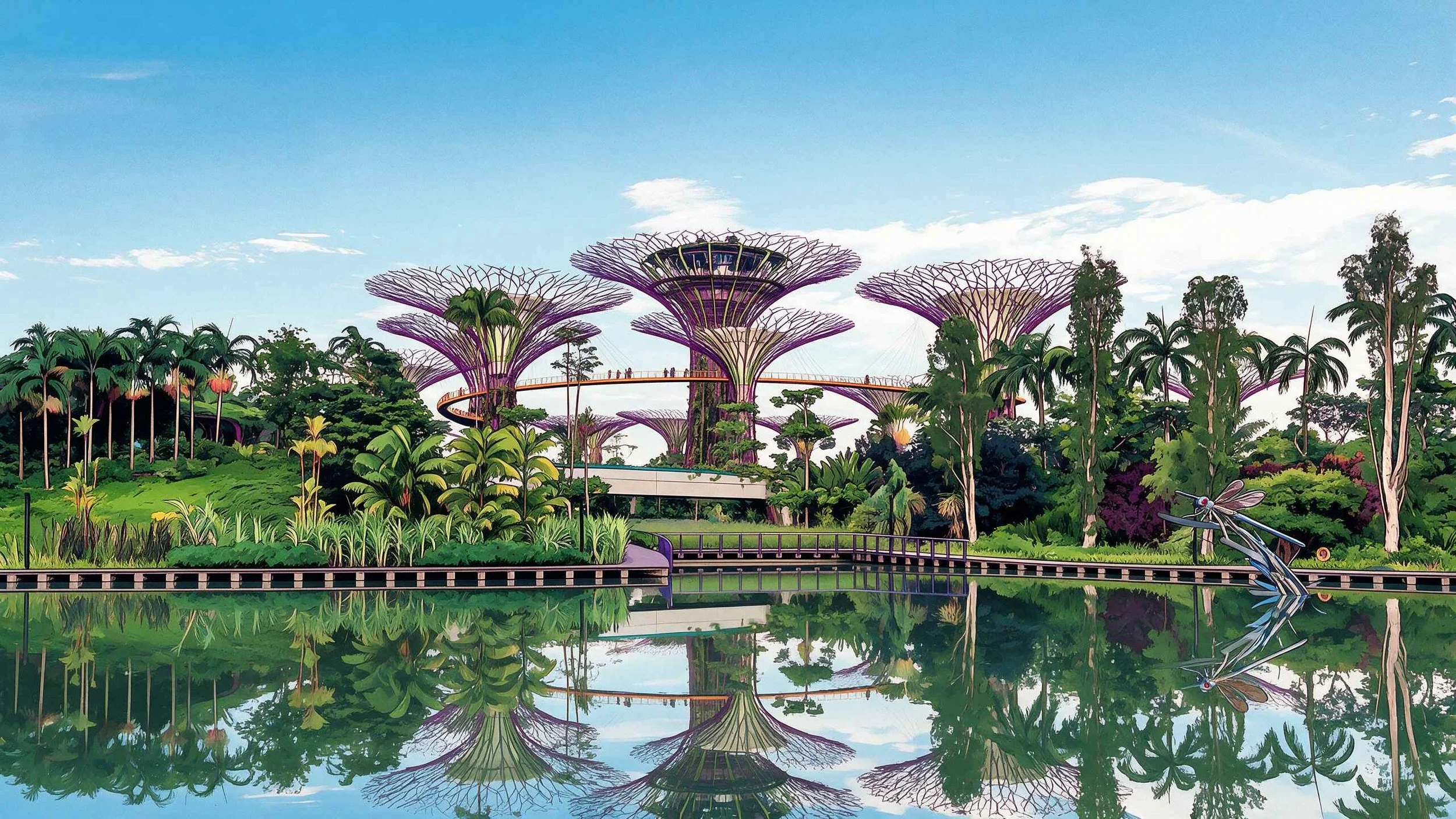
Film Anchor: The film reports that around seventy per cent of people will live in cities by 2050, and looks at what that does to us. In South Korea it links the stress of city life to high rates of depression and a rise in youth suicide, and follows forest-healing programmes, endorsed by the government, that take students out of the city to recover. Then it reaches Singapore, a city built with nature running all the way through it: greenery planted onto buildings, cleaned-up waterways that have drawn otters back, and even a public hospital full of plants where patients heal among birds. The reaction in the film is that this feels like a blueprint for a future worth living in, with nothing given up.
Students take a street, corridor or corner of the school and redesign it to bring in nature the way Singapore does, from planting on buildings to water that invites wildlife back. They explain what each change would do for people and for other species.
Students survey the routes they use every day and map where nature is present and where it is absent. They mark the places a small change would matter most and set out why.
GreenComp 2.1Listening to a Reef
Film Anchor: Steve Simpson, a marine biologist, measures a reef's health by its sound. A thriving reef crackles and pops with fish, while a bleached one falls acoustically silent, like a graveyard. To bring a dead reef back, his team records the sound of a healthy one and plays it underwater to lure young coral and fish to settle. They cut heat-tolerant corals into fragments, grow them on, and plant them out with a farming damselfish as a bodyguard and a speaker playing reef sound, and hope to see a stunning reef again within a decade.
Students discuss why a healthy reef crackles with sound and a bleached one falls silent, and how the team used that difference to rebuild a habitat with heat-tolerant coral, guardian damselfish and a speaker. They treat sound as a measure of whether a system is alive.
Students record or simply listen at several points around the school grounds and map where they hear the most living sound. They ask what the quiet places have in common and what would bring life back to them.
7.The Turning Point: From Chapter Three to Chapter Four
The film needs to show that reversal is not a dream, and it does so on the Klamath River. The river's Indigenous families describe a drought year, 2002, when the water above four hydroelectric dams grew warm and disease spread. The film reports that more than eighty thousand adult Chinook salmon died, the largest fish kill in the country's history, and entirely man-made. One young man decided to become a lawyer to stop it happening again. After a legal battle of some twenty years, all four dams were removed and about four hundred miles of habitat were reopened, described in the film as the biggest river restoration in the country's history. No one expected the salmon to reach the upper spawning grounds in the first year. They did. This is the film's proof that we can move Earth on to its fourth chapter, and it makes a strong capstone.
GreenComp 4.2 and 4.1The Four Hundred Mile Question
Students reconstruct the Klamath story as a sequence of decisions and actions across two decades, from the fish kill to the dams coming down. They identify who had to act, who had to be persuaded, and what kept people going through a long effort. They then weigh the film's underlying question: what is the value of a living river for all the generations to come, and how would you ever cost that up?
Students work with an appropriate local organisation on a small, real restoration or advocacy project with a defined ecological purpose, such as habitat improvement or a submission on a local decision. The aim is a genuine collective action on a modest scale, not general volunteering.
8.A Screening-to-Action Model
The companion reduces to five steps, which take a class from watching the film to acting on it.
- 1WatchThe film, or one of its three questions.
- 2QuestionAsk which direction the film took, and whether it convinces.
- 3InvestigateTest the film's cases against local evidence and observation.
- 4EvidenceWeigh what you found before deciding anything.
- 5ActOne thing to protect or restore, individual or collective.
9.Screening Notes and Curriculum Fit
The film premieres globally on YouTube on 20 September 2026 at 8pm CEST and stays free to watch afterwards, so there is no cost barrier for schools. Watching the live premiere makes a strong shared moment where timing allows, and the film works just as well screened later in class. It suits students aged 11 to 16, and works for teacher training and staff sessions too.
The three questions give three natural break points. Show the film in full with older groups, or split it across three lessons for younger ones, taking one question at a time.
| Part | Question | Curriculum Fit |
|---|---|---|
| One | How to Value Nature | Science, Geography |
| Two | How to Feed the Future | Science, Geography, Food |
| Three | How to Feel Human | Citizenship, PSHE, Wellbeing |
| Close | The Klamath Turning Point | Citizenship, Geography |
Set one question before each part so students watch with a purpose, then pause and take answers. A good closing task across any part is a commitment: each student or group names one thing they will protect or restore, and reports back the following week.
10.Principles for Educators
The film is a strong starting point, not a whole curriculum. A few principles keep the teaching grounded and inspiring.
- Hold honesty and hope together. The film is open about the scale of the problem and still focused on solutions. Keep both. Students should understand the stakes without being left in despair.
- Attribute knowledge to its people. Where the film draws on Indigenous knowledge, from the Otomi community in Mexico to the families of the Klamath River, name the specific people and place rather than presenting it as a general idea.
- Test the claims. Treat the film's figures and cases as evidence to examine, not facts to accept. Comparing them with local observation is itself the lesson.
- Keep it local. A question about the students' own street, pond or canteen usually teaches more than a distant example. The film supplies the idea; the neighbourhood supplies the practice.
- Let students answer the question. The film ends on "almost". Leave that open, so students reach their own view through their work rather than repeating a conclusion.
Discussion
Questions for educators planning to use the film.
Which of the three questions fits your subject and students best?
Where in your local area could students test one of the film's cases against real evidence?
Which GreenComp competence do your students find hardest to practice rather than define?
What picture of local change would students need before deciding what to do?
What one action could a class realistically carry through to the end?
The strongest starting point is usually close to home: one question, one place, one competence, one action.
Sources and Further Reading
How to Live on Earth (2026). Open Planet Studios. Presented by Benedict Cumberbatch. All descriptions, cases and figures in this companion are drawn from the film itself. Global YouTube premiere 20 September 2026.
Bianchi, G., Pisiotis, U. and Cabrera Giraldez, M. (2022). GreenComp: The European Sustainability Competence Framework. Punie, Y. and Bacigalupo, M. (eds). EUR 30955 EN. Luxembourg: Publications Office of the European Union. JRC128040. Reused under the Creative Commons Attribution 4.0 licence.
European Commission. Education for Climate Coalition. A community of practice supporting learning for the green transition, aligned with GreenComp.
This companion is built on the three questions the film sets itself and on the European Commission's GreenComp framework, which is a non-prescriptive reference. The activities are illustrative starting points for educators to adapt to their own students, settings and local context.
Coming Soon

How To Value Nature - Student Worksheet
How To Feed The Future - Student Worksheet
How To Feel Human - Student Worksheet
Teacher’s Notes